
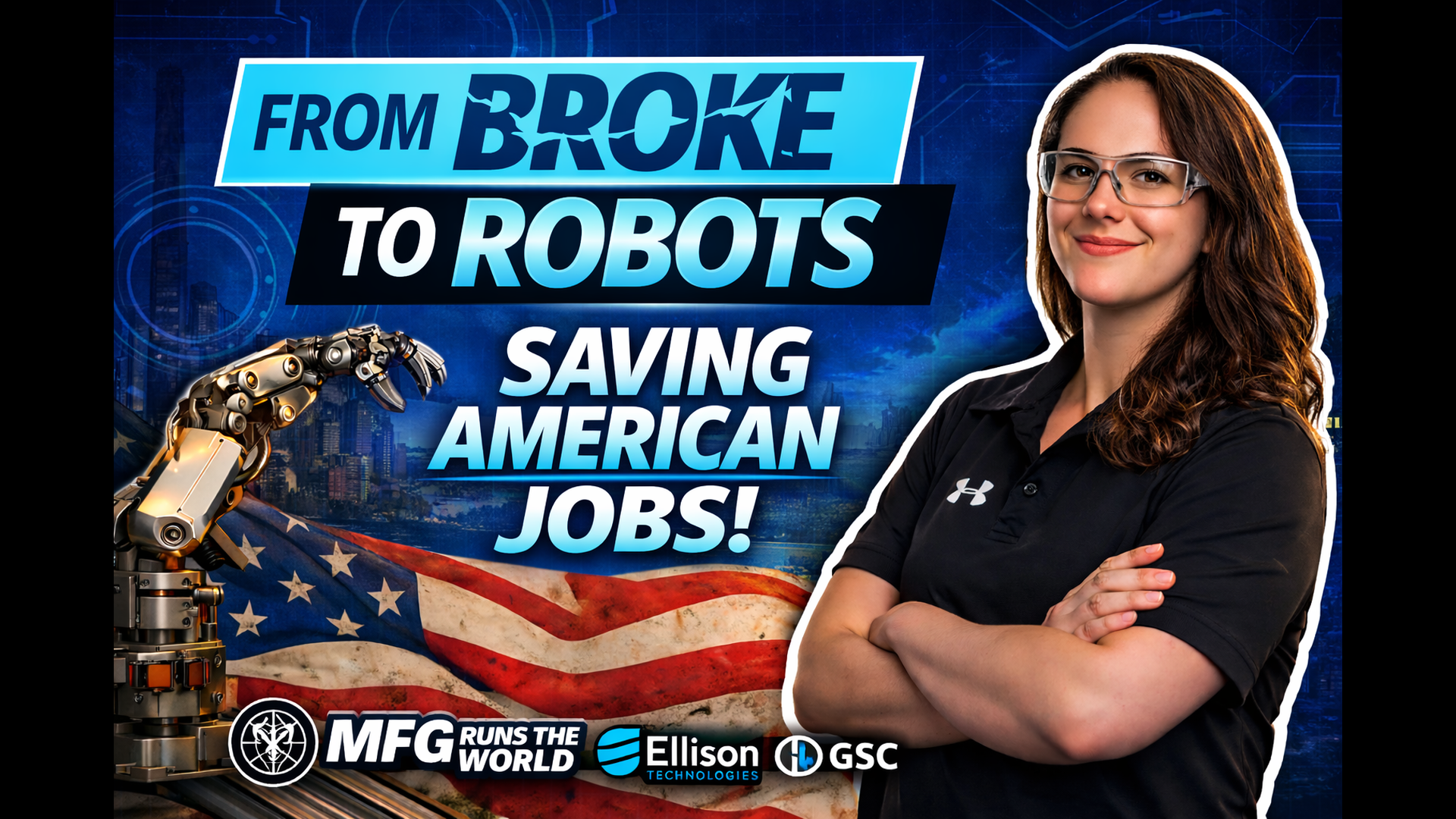
Why the First Robot Changes Everything in Manufacturing
Most people think automation is a technology decision. It’s not. It’s a belief decision—and that belief usually changes the moment the first robot actually works.
I’ve seen this play out over and over again talking to manufacturers. On paper, the ROI makes sense. The technology checks out. Leadership is aligned. And yet… nothing moves. Because the real barrier isn’t the robot—it’s whether people actually believe it’s going to work.
The Moment Everything Shifts
If you’ve ever been part of an automation project, you’ve probably felt the tension that shows up early on. People are polite about it, but you can tell what they’re thinking. There’s a lot of “let’s see how this goes,” and not much real conviction behind it. Some of that hesitation is practical. Automation changes workflows, introduces new systems, and forces people to adjust how they’ve been doing their jobs for years.
But underneath that, there’s usually something deeper—doubt about whether it’s actually going to work in this environment, with these constraints, and these people. And if you ignore that, no amount of technology is going to save you.
“Robots Are Taking My Job”
You see it clearly when a new system is introduced on the floor. In one case, a snack manufacturer in Ohio was trying to turn around a struggling operation. They didn’t have excess capital, hiring was already a challenge, and like a lot of legacy facilities, change didn’t come easy. When automation came in, the reaction wasn’t excitement—it was concern.
People assumed jobs would disappear. Forklift drivers pushed back. There was tension, even if no one said it outright. And honestly, that reaction makes sense. If you’ve spent years mastering a job and something new shows up that might replace it, you’re not going to welcome it with open arms. Most companies underestimate that part completely.
Why Most Automation Efforts Stall
This is where a lot of automation efforts quietly fall apart. It’s not because the technology is wrong. It’s not because the ROI isn’t there. It’s because the organization never fully commits.
Leadership might be bought in. The numbers might look great. But on the floor, where the work actually happens, there’s hesitation—and hesitation creates friction. I think this is where a lot of manufacturers get frustrated. They invest in the system, but they don’t invest in the adoption, and then they wonder why it never fully delivers.
Friction doesn’t just slow things down—it compounds. Over time, what should have been a breakthrough ends up feeling like a marginal improvement.
Then the Robot Starts Moving
At some point, though, there’s a moment that changes everything. It doesn’t happen in a meeting or on a spreadsheet. It happens on the floor, when the robot actually starts running.
People stop what they’re doing and watch. At first, they’re looking for something to go wrong. You can see it—arms crossed, hands on hips, waiting for the failure. But then it keeps working. It picks up boxes, places them down, and repeats the process without hesitation. Smooth. Consistent. Predictable.
And then the energy shifts. Phones come out. People start recording. Conversations change. What started as skepticism turns into curiosity, and then into something closer to excitement. That’s the moment you win them—and it has nothing to do with the spec sheet.
From Fear to Momentum
Once that shift happens, everything else gets easier. In that Ohio facility, the first successful deployment didn’t just solve a single problem—it created momentum. They started expanding automation, adding new capabilities, and growing in ways they couldn’t before.
I’ve seen this pattern enough times now that it’s predictable. One robot turns into two. Two turns into a broader strategy. What starts as a test becomes something much bigger. But it never starts with scale—it starts with a win.
Why the First One Matters More Than the Rest
The first robot is different from every one that comes after it. It carries all the uncertainty, all the skepticism, and all the resistance. It’s where everything can go wrong—or everything can click.
Once it works, the conversation changes. You’re no longer trying to convince people automation might work. You’re showing them that it already does. And at that point, something interesting happens—you stop pushing it, and people start asking for more.
The Real Constraint Isn’t Technology
Manufacturing doesn’t struggle with automation because the technology isn’t ready. It struggles because people aren’t ready to trust it.
That’s the real bottleneck. And I think this is where the conversation needs to shift. We spend so much time talking about what robots can do, and not nearly enough time talking about what it takes for people to accept them. Because until that happens, none of it scales.
What This Means for Leaders
If you’re thinking about automation, the goal isn’t to roll out a massive, fully optimized system right away. That approach sounds good in theory, but in practice, it usually creates more resistance than progress.
The goal is to get the first one right. Pick the right use case. Stay close to the floor. Make sure people understand what’s happening and why. And most importantly, make sure it works in a way they can see and trust.
Because once that happens, everything starts to move faster.
Manufacturing Doesn’t Change All at Once
Real change in manufacturing doesn’t happen overnight. It happens one proof point at a time—one system, one line, one moment where something that used to feel risky suddenly feels obvious.
And once you cross that line, there’s no going back.
Final Thought
Automation doesn’t transform a business the moment you invest in it. It transforms a business the moment people believe in it.
And in most cases, that belief starts with the first robot.