
Most People Think Manufacturing Is High-Tech. Sometimes, It Isn’t.
We like to talk about smart factories, automation, and AI. The narrative around manufacturing today is filled with images of robots, real-time dashboards, and highly optimized systems running with precision and speed. From the outside, it feels like the industry has already fully evolved into something futuristic.
But when Kyle Fenstermacher, a manufacturing engineer early in his career, stepped into a real production environment, what he found didn’t match that narrative at all. It caught him off guard in a way that most people outside the industry would never expect.
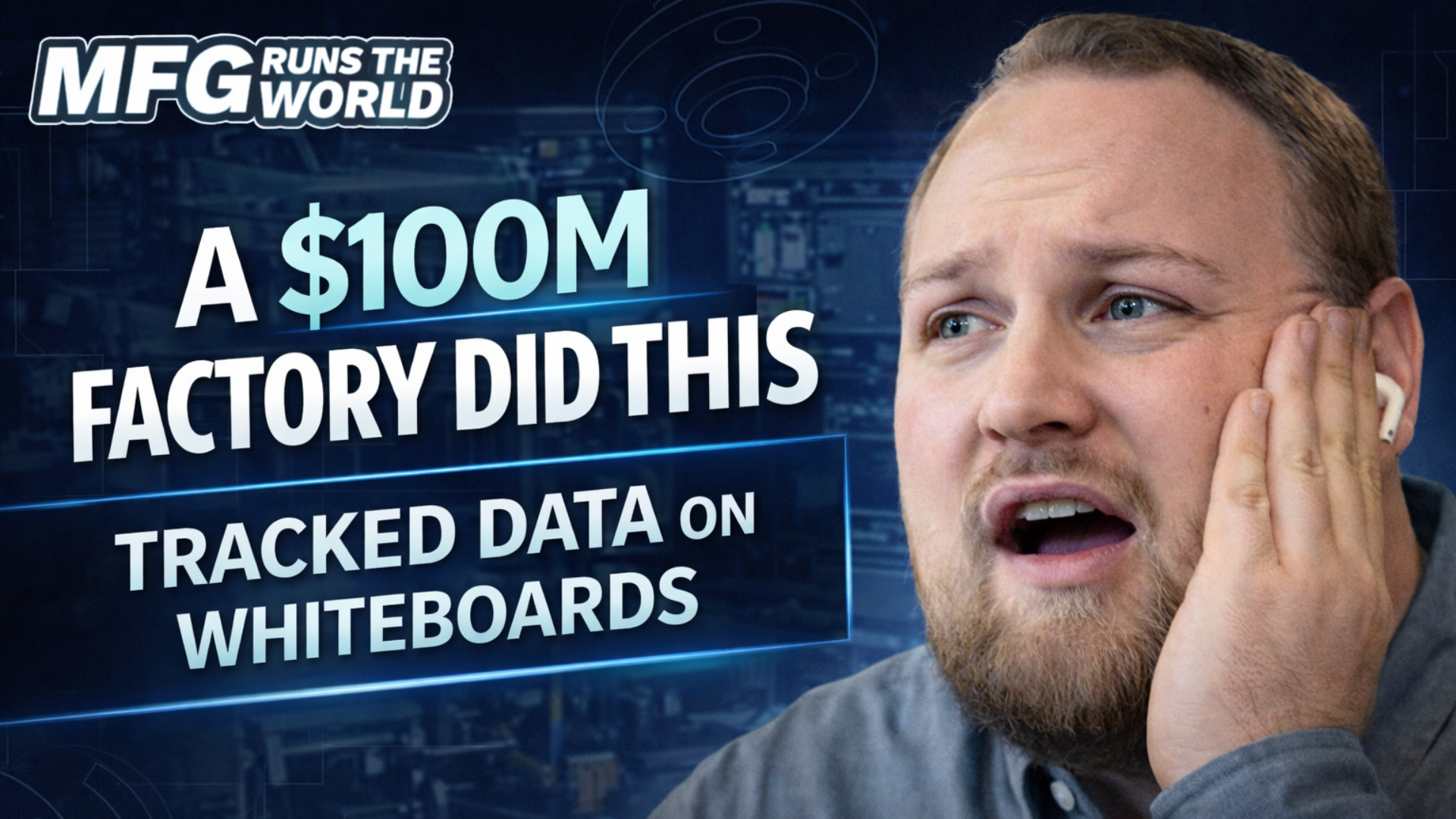
One of the most critical functions in the entire operation, production tracking, was being handled manually. Every hour, line leaders would write down their output on whiteboards. Someone else would walk the floor, collect those numbers, and pass them along to another person who would manually enter everything into Excel.
This wasn’t a temporary workaround or a short-term fix. This was the system. And it had been in place for years. That realization alone challenges what most people think manufacturing actually looks like today.
Why Outdated Systems Survive Longer Than They Should
From the outside, it is easy to ask how something like that continues to exist. It seems inefficient, fragile, and completely avoidable. But inside a manufacturing environment, the answer is rarely that simple.
Production has to keep moving. If a system works well enough to get the job done, even if it is far from ideal, it tends to stay in place. Replacing it introduces risk. It requires training, time, and attention that teams often cannot afford to give. There is always another fire to put out, another deadline to hit, another order to fulfill.
Over time, inefficiencies like this do not just exist, they become embedded. They turn into habits. They become part of the culture. People stop questioning them, not because they are good, but because they are familiar. That is how outdated systems quietly survive for years without being challenged.
The Fix Wasn’t a Million-Dollar System
What makes Kyle’s story interesting is not just the problem, it is how simple the solution was. There was no massive capital investment, no enterprise software rollout, and no outside consultants driving the change.
Instead, Kyle worked with a colleague who had been teaching himself programming. Together, they built a straightforward digital system that allowed line leaders to input their production numbers directly using iPads. Those inputs fed into a live dashboard that updated in real time, giving visibility across the operation.
The process itself did not fundamentally change. The same people were doing the same work in the same environment. What changed was the visibility and the speed at which information moved. That shift alone created a level of clarity the organization had never had before. In manufacturing, that kind of clarity can unlock more value than adding complexity ever could.
Automation Isn’t What You Think It Is
When most people hear the word automation, they picture large robotic systems like the ones seen in automotive plants. And while those systems exist, they are only a small part of what automation actually looks like on the ground.
Kyle’s experience highlights a much more practical reality. Automation often shows up in smaller, more accessible ways that do not get talked about. It can be replacing a manual tool with a pneumatic one that reduces hours of labor down to minutes. It can be designing a fixture that ensures consistency instead of relying on human variability. It can be using 3D printing to create a tool overnight instead of waiting weeks for a machine shop to deliver it.
These changes are not flashy, but they are meaningful. They remove friction from the process, reduce variability, and make work more repeatable. When applied consistently, they compound into significant operational improvements.
The Real Risk Isn’t Technology. It’s Communication.
One of the most important lessons from Kyle’s experience did not come from a successful project. It came from one that failed. He was involved in a project that stretched out for more than a year before ultimately being scrapped, and the reason had very little to do with the technology itself.
The breakdown was in communication. Discussions happened and meetings were held, but expectations were never clearly documented or aligned. Without a shared understanding, the project slowly drifted off course until it reached a point where it could not be recovered.
What this highlights is something many manufacturing leaders understand but do not always formalize. Communication is not just a soft skill, it is a system. Following up meetings with written summaries, defining responsibilities, and aligning on expectations are not administrative tasks. They are operational safeguards that can prevent months of wasted time and effort.
Where Kyle’s Work Fits in the Manufacturing Supply Chain
To really understand the impact of Kyle’s work, you have to zoom out and look beyond a single facility. He works at a company like Universal Laser Systems, which builds equipment that other manufacturers depend on. That places his role upstream in the manufacturing supply chain, where the impact is less visible but often more far-reaching.
His company is not producing the final product that consumers interact with. Instead, they create the tools and systems that other manufacturers rely on to produce their own products. That means the fixtures he designs and the processes he improves do not just affect one company. They influence multiple layers of production across different industries.
Manufacturing is not a single company building a single product. It is a network of specialized companies, each contributing a piece. One builds components, another builds the equipment used to produce those components, and another integrates everything into a final system. By the time a finished product reaches the market, it represents the work of dozens, sometimes hundreds, of companies working together in sequence.
Kyle’s role exists within that network, improving one link in a much larger chain. And when one link gets better, the impact extends far beyond what most people ever see.
Why This Story Matters More Than It Seems
For people outside the industry, this story can be surprising because it challenges the idea that manufacturing is either fully automated or completely outdated. For people inside the industry, it likely feels more familiar than they would like to admit.
The real takeaway is not about one engineer fixing one process. It is about mindset. Modern manufacturing is not defined by how advanced your technology is. It is defined by how willing you are to question the systems you have accepted over time.
Progress rarely comes from massive, sweeping changes. More often, it comes from small, consistent improvements made by people who are willing to challenge inefficiencies that others have learned to live with.
The Gap No One Talks About
There is a clear disconnect between how manufacturing is perceived and how it actually operates. From the outside, it is easy to imagine extremes. Either fully automated facilities run by robots or outdated environments stuck in the past.
The reality is far more nuanced. It is engineers solving problems in real time, teams balancing manual processes with automation, and organizations constantly iterating to improve performance. It is not perfect, and it is not static. It is a continuous process of adjustment and improvement that rarely gets seen by the public.
Final Thought
If you want to understand modern manufacturing, do not start with the machines. Start with the people who are willing to challenge what has been accepted for years.
Because the companies that move forward are not always the ones with the newest technology. They are the ones that refuse to accept inefficiency as normal and take action to fix it.