
Most people never think about the equipment behind the products they use every day.
They see a sealed window, a silicone tube, a hospital hose, a syringe, a deck board, or a pharmaceutical-grade material and assume it simply exists. But behind many of those everyday products is a much bigger story: raw materials, industrial mixing, process testing, contamination control, maintenance schedules, equipment sizing, and engineering decisions that can determine whether a manufacturer makes money or burns through it.
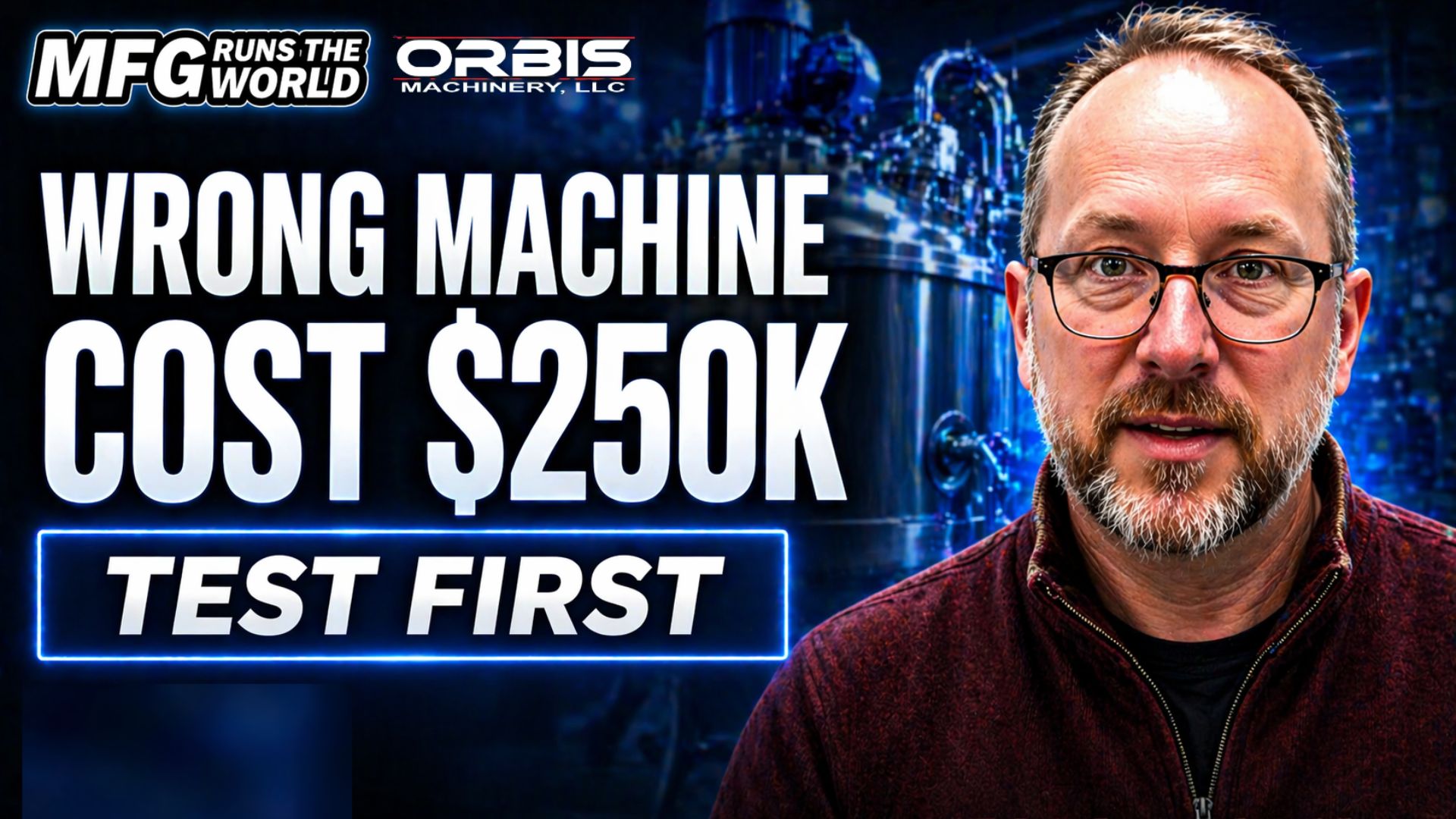
That was one of the biggest takeaways from my conversation with Nathan Pliska, a mechanical engineer with more than 20 years of engineering design experience. His background includes heavy-duty equipment, process equipment, sampling systems, ASME pressure vessels, jacketing systems, and industrial mixers used to create the base materials that eventually become real-world products.
The Products We Use Start Somewhere Else
One of the most interesting parts of this conversation was how far removed the equipment can be from the final product.
Nathan explained that the machines he works with may produce feedstock for deck boards, silicone tubing, pharmaceuticals, baby care products, hospital hoses, syringes, and window sealants. In other words, the machine does not always make the thing you see on the shelf. It may make the material that another manufacturer heats, extrudes, forms, finishes, packages, or turns into the product you actually recognize.
That is the part of manufacturing most people never see.
The contractor sealing a window may never think about the industrial mixer that helped create the compound in that tube. The patient in a hospital may never think about the process equipment involved in making the silicone material used in a disposable hose or medical component. The homeowner walking across a deck may never think about the raw material feedstock that existed long before the board was installed.
But that hidden chain is exactly why manufacturing is so fascinating. Every finished product has a backstory. And often, that backstory starts with a machine most people have never heard of.
The Wrong Equipment Decision Can Become a Very Expensive Lesson
One of the strongest lessons from the episode is simple: buying the wrong equipment can be brutally expensive.
Nathan talked about customers who come in expecting one size of machine, only to discover through testing that their production needs require something dramatically larger. In one example, the expected jump was from something like a 100-gallon machine to a 1,000-gallon machine. That changes everything. It changes the capital expense. It changes the economics. It may even change whether the process makes business sense at all.
This is a point a lot of people outside manufacturing miss.
A process can technically work and still be the wrong answer.
That is a hard truth. You might prove that a material can be mixed, ground, processed, or refined. You might even get the result you wanted. But if it takes too long, requires equipment that is too large, or creates costs that destroy the margin, then it may not be a viable production process.
That is why lab testing matters. It gives the customer a chance to learn the truth before spending serious capital. It is much better to discover the economics do not work during testing than after buying a machine that cannot meet production needs.
Testing Is Not a Delay. It Is Risk Management.
In manufacturing, testing can sometimes feel like a slowdown. Everyone wants to move fast. Everyone wants the answer. Everyone wants the machine installed and running.
But Nathan’s perspective shows why testing is not just a technical step. It is a business protection step.
His team can use lab processing to run smaller batches, collect basic data, evaluate horsepower and torque requirements, and help determine whether a specific piece of equipment is right for the job. Sometimes the test shows that nothing meaningful is happening, which is actually valuable information. It means the customer can avoid investing in the wrong process.
Other times, the test reveals a better path.
Nathan shared an example where a customer was trying to grind recycled material to a specific size. Early tests did not deliver the result. Then they changed the media charge in a ball mill and suddenly the process worked. That one adjustment changed the outcome.
That is modern manufacturing in a nutshell. It is not just “buy a machine and press go.” It is process knowledge, experimentation, engineering judgment, and economic reality all colliding at once.
Maintenance Problems Become Production Problems
Another powerful theme from the conversation was how small equipment details can create large operational consequences.
Nathan talked about sealing systems on industrial mixers. When you have moving shafts, rotating parts, heat, cooling, expansion, contraction, access points, and dense materials being processed, leaks and contamination risks become real concerns. Traditional rope packing has been an industry standard, but it requires regular preventive maintenance to keep it tight and functioning properly.
That may sound like a small maintenance issue, but in production, small issues rarely stay small.
If a seal creates contamination, the result can be lost product, extra filtration, downtime, rework, downgraded material, or scrapped batches. In pharmaceutical-grade silicone, Nathan mentioned that contamination can force a company to throw away a $20,000 to $30,000 batch or downgrade it to industrial use.
That is the hidden cost of manufacturing quality.
People often think quality assurance is just a final inspection step. In reality, quality is built into the machine design, the maintenance schedule, the raw material handling, the filtration process, the seals, the clearances, and the decisions engineers make long before the final product exists.
Better Engineering Frees People Up for Better Work
One of the most practical examples from the episode was the shift from rope packing to air seals.
Nathan explained that some customers tested air seal technology, saw major improvement, and eventually retrofitted their equipment. The result was a dramatic reduction in preventive maintenance, fewer contamination concerns, and maintenance teams being able to focus on bigger problems instead of repeatedly tightening or servicing packing systems.
That is an underrated part of innovation in manufacturing.
Not every improvement looks like a robot, a massive automation cell, or a futuristic AI system. Sometimes innovation is a better seal. Sometimes it is a better maintenance interval. Sometimes it is removing one recurring pain point that has quietly been costing a company time, money, and attention for years.
That is where real manufacturing improvement often happens. It is not always flashy. But it compounds.
Customer Service Is Still Engineering
Another thing that stood out is how hands-on this work can be.
When a customer has a contamination issue, Nathan described the need to be “boots on the ground.” The question becomes: Is the equipment causing the issue? Is the seal contributing to contamination? Is metal rubbing on metal? Are the design clearances creating risk? Can the machine be improved to better handle expansion and contraction while still performing properly?
That is not generic customer service. That is applied engineering.
The best manufacturing companies are not just selling equipment. They are learning from how that equipment performs in real environments. They are taking customer pain points back into the design process. They are using field problems to improve future machines.
That loop matters: design, test, install, observe, improve.
The customer gets better equipment. The manufacturer gets better knowledge. And the next machine benefits from the lessons learned in the field.
The Bigger Lesson
The big lesson from this conversation is that manufacturing decisions are rarely just technical decisions.
Choosing the wrong equipment can waste capital. Choosing the wrong process can destroy margins. A small contamination issue can wipe out tens of thousands of dollars in product. A seal design can affect maintenance schedules, quality assurance, labor allocation, and customer profitability.
That is why manufacturing deserves more respect.
The world sees the finished product. Manufacturing sees everything that had to go right before that product ever existed.
And sometimes, the most important work happens long before anything reaches the customer. It happens in the lab. It happens during testing. It happens when an engineer asks whether the machine is actually right for the job. It happens when a maintenance problem gets solved at the design level instead of being accepted as “just how it is.”
That is the part of manufacturing people do not see.
But it is also the part that makes everything else possible.