
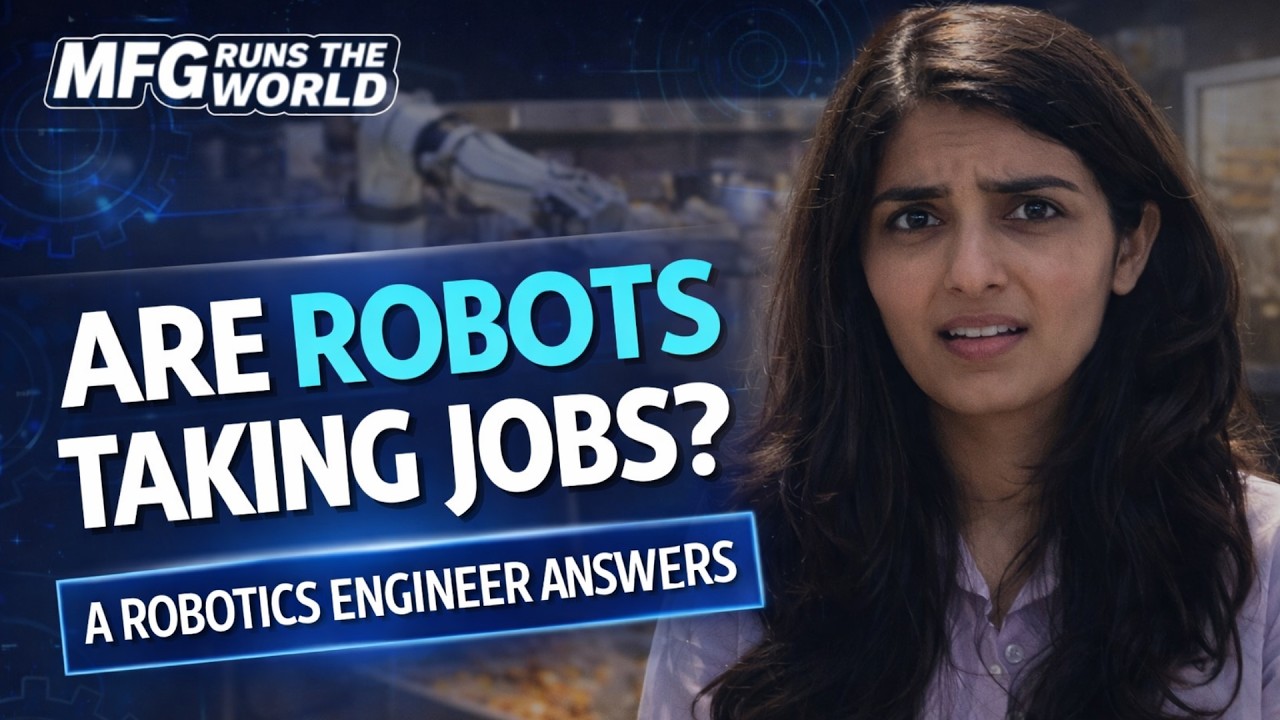
“Are robots going to take over the world?”
That is one of the first questions people ask when they find out someone works in robotics. It is a fair question. Automation is no longer something hidden inside massive factories or futuristic concept videos. It is showing up in restaurants, warehouses, machine shops, distribution centers, farms, and everyday businesses that most people interact with without even realizing it.
But the more interesting question is not whether robots are coming.
They are already here.
The better question is: what kind of work are they actually replacing, and what kind of work are they creating?
In a recent conversation on Manufacturing Runs The World, Justin Schnor sat down with a robotics engineer from Miso Robotics, the company behind Flippy, a robot designed to work at fry stations in fast food restaurants. On the surface, that might sound like the exact kind of story people worry about. A robot doing a job a person used to do. A machine stepping into a restaurant kitchen. Another example of automation replacing labor.
But once you hear what the job actually looks like, the story gets more complicated.
And honestly, more hopeful.
The Job Nobody Is Romanticizing
A fry station is not some comfortable, creative, fulfilling role that people are fighting to keep forever.
It is hot. It is repetitive. It can be physically uncomfortable. There is burn risk. There is constant pressure. And in many restaurants, someone may be expected to stand there for hours doing the same task over and over again.
During the conversation, the robotics engineer explained that she had wrestled with the same concern many people have. When she took the job, she wondered whether she wanted to work on something that could be seen as taking people’s jobs.
That question matters.
It means the people building this technology are not always blind to the consequences. The best engineers are not just thinking about whether a robot can perform a task. They are also thinking about where it fits into the lives of real workers, real businesses, and real industries.
Then she visited restaurants where Flippy had been installed.
The reaction was not what the “robots are stealing jobs” narrative would lead you to expect.
Workers were happy to have it.
One restaurant even held a birthday party for Flippy after the robot had been there for a year.
That detail says a lot. People do not usually throw birthday parties for machines they resent. They do it when the machine has become part of the team. Maybe not in the same way a human coworker is part of the team, but in a way that makes everyone’s day a little easier.
Automation Does Not Eliminate Work. It Changes the Work.
This is where the public conversation around automation often falls apart.
People talk about “jobs” as if every job is one solid thing. But most jobs are actually a bundle of tasks. Some of those tasks require judgment, communication, decision-making, adaptability, empathy, creativity, or troubleshooting. Others are repetitive, physically demanding, dangerous, or dull.
Automation usually attacks the task before it attacks the job.
That distinction matters.
A robot at a fry station may take over the repetitive act of handling baskets and cooking food. But that does not mean the entire restaurant stops needing people. It may mean the people working there shift toward customer interaction, problem-solving, maintenance, oversight, food prep, training, quality control, or learning how to work with the automation itself.
For manufacturing leaders, this is not theoretical. It is already happening across plants, shops, and production floors.
Robots weld parts, tend machines, move materials, inspect products, package goods, and perform tasks that once required a person to stand in one place all day. But in the strongest companies, the goal is not simply to remove people. The goal is to remove the worst parts of the work so people can be redeployed into roles that are safer, more skilled, and more valuable.
That does not mean there are no disruptions. Of course there are. Some jobs do become obsolete. Some workers do need training. Some companies handle transitions poorly. Pretending otherwise would be dishonest.
But it is equally dishonest to pretend every automated task represents a net loss for humanity.
Sometimes automation is not replacing a dream job.
Sometimes it is replacing the part of the job nobody wanted to do in the first place.
The Real Fear Is Not Robots. It Is Being Left Behind.
For the general public, the fear of automation often sounds like this:
“What if a robot takes my job?”
For manufacturing leaders, the fear is usually different:
“What if we cannot find enough people to do the work?”
Across manufacturing, food production, logistics, fabrication, machining, and industrial automation, companies are dealing with labor shortages, skills gaps, rising expectations, tighter margins, and pressure to produce more with fewer people. Many of them are not automating because they want a workerless future. They are automating because the old model is no longer holding up.
A company may have machines sitting idle because there are not enough operators.
A shop may turn away work because it cannot find skilled labor.
A production line may struggle because too much of the process depends on one person doing one repetitive task perfectly for eight hours straight.
In that environment, automation is not just a cost-saving tool. It is a survival tool.
And when done right, it can be a workforce development tool.
The robotics engineer in this conversation made a comparison to coding. People have said that AI tools will make coding jobs obsolete. But her view was different. Tools like Copilot and ChatGPT can make coding faster and more accessible. Instead of eliminating the field, they may allow more people to participate in it.
That same idea applies to robotics and manufacturing.
A person who never imagined themselves as a programmer might learn to operate automated equipment. A worker who started on a repetitive task might become the person who monitors, maintains, or improves the system. A technician who once relied only on mechanical skill may start working with software, sensors, data, and controls.
The job changes.
And in many cases, the ceiling gets higher.
Robotics Is Not Magic. It Is Manufacturing, Software, Controls, and Problem-Solving
One of the most valuable parts of the conversation was the explanation of what a roboticist actually does.
A robot is not just a metal arm moving around.
It is mechanical design. It is electronics. It is controls. It is software. It is simulation. It is real-world testing. It is site-specific problem-solving. It is figuring out why something that worked in a simulation does not work the same way in a real restaurant, with a real fryer, in a real space, surrounded by real operational constraints.
That is the part the public rarely sees.
Modern automation is not just “plug in a robot and replace a human.”
It is constant iteration.
Maybe one fryer model has a slight slope on the edge that changes how the robot needs to move. Maybe a restaurant layout creates a constraint that did not exist in testing. Maybe a robot in the field goes down and the team needs to troubleshoot quickly because the restaurant cannot afford downtime.
This is where manufacturing leaders should pay attention.
Scaling automation is not about buying technology and assuming the problem is solved. It is about integration, support, training, service, process knowledge, and cross-functional communication.
The companies that win with automation are rarely the ones chasing the flashiest robot. They are the ones that understand the work deeply enough to know where automation actually belongs.
The Most Important Engineering Lesson Was Not Technical
When asked about mistakes she made early in her career, the robotics engineer did not give a complicated technical answer.
Her answer was simple: she did not ask enough questions.
That may sound basic, but it is one of the most important lessons in engineering, manufacturing, robotics, and leadership.
Early in a career, people often feel pressure to prove they belong. They think they are supposed to know everything. So they stay quiet. They try to figure it out alone. They make assumptions. They waste time. They get things wrong.
Eventually, the better lesson reveals itself: confidence does not come from pretending to know. Confidence comes from being willing to ask.
That lesson is especially important in automation because no one person understands the entire system alone. Robotics sits at the intersection of mechanical engineering, electrical systems, controls, software, operations, maintenance, safety, and business reality.
The person who asks better questions gets to the real problem faster.
For young people looking at manufacturing, this should be encouraging. You do not have to enter the industry knowing everything. You have to be curious enough to learn, humble enough to ask, and persistent enough to solve problems that do not always have obvious answers.
For manufacturing leaders, it is a reminder that culture matters. If your team is afraid to ask questions, your automation projects will suffer. If people are punished for not knowing, they will hide problems until those problems become expensive.
A strong automation culture is not built on pretending everyone has the answer.
It is built on making sure the right questions get asked early enough.
Manufacturing Has an Image Problem Automation Can Help Fix
One of the biggest misconceptions about manufacturing is that it is dirty, boring, and dying.
That image is outdated.
Modern manufacturing is increasingly technical, digital, automated, and interdisciplinary. The factory floor is no longer just a place where people repeat the same motion forever. It is becoming a place where people interact with robots, software, data, sensors, vision systems, simulation tools, and connected machines.
Automation can help change how the next generation sees the industry.
A teenager may not be excited by the idea of standing at a station doing repetitive work. But they may be excited by robotics. They may be interested in programming. They may want to work with machines that move, think, sense, and adapt. They may want a career that blends physical systems with software and real-world problem-solving.
That is a massive opportunity for manufacturing.
But only if the industry tells the story correctly.
If the public conversation around automation stays trapped in fear, we miss the chance to show people what modern manufacturing actually looks like. We miss the chance to explain how robots are built, how they are programmed, how they are maintained, how they are integrated, and how many people it takes to make automation work in the real world.
The robot may be the thing people notice.
But the real story is the network of humans behind it.
The Honest Answer
So, are robots taking jobs?
The honest answer is yes, sometimes.
But that is not the whole answer.
Robots are also taking tasks people do not want to do. They are making dangerous work safer. They are helping businesses operate when labor is hard to find. They are creating new technical roles. They are making coding, robotics, and automation more accessible. They are forcing companies to rethink what human work should look like.
The future of work is not as simple as humans versus robots.
It is humans deciding what work is worth doing, what work should be automated, and how to build companies where technology improves the quality of life instead of simply cutting headcount.
That is the responsibility.
For the public, the takeaway is this: automation is not always the villain. Sometimes it is the thing that removes the worst part of the job.
For manufacturing leaders, the takeaway is bigger: automation cannot just be a productivity strategy. It has to be a people strategy.
Because the companies that get this right will not be the ones that replace the most workers.
They will be the ones that build the best systems, create better jobs, and help more people see that modern manufacturing is not dying.
It is evolving.